Education, learning and skills for people with deaf blindness in Bangladesh
01 Jul 2025
Deafblindness refers to a combined hearing and visual impairment that significantly affects communication, learning, mobility, and independent living. PAPRI’s project supports deafblind children and adults through assessment, individualized education, home-based ADL training, therapy, assistive devices, healthcare, education, livelihood support, and family capacity building, promoting greater independence and inclusion.
Background of the Project:
Ever since the beginning, PAPRI has been playing a significant role on the disabled issue and closely eyeing in its working area for the betterment of the people from all sorts of disabilities and trying best for being brought out and aggregated them under a safe umbrella through introducing different activities and support program from different corners.
To erase the situation and create a comfort zone for the persons with disabilities, PAPRI teamed up itself with likeminded other development partners at home and abroad aimed to gear up the mobility and enhance the socio-economic condition of the people having severities in the area of deafblindness in the rural area, especially in Narsingdi district.
To address the mentioned project PAPRI has made an agreement with the Centre for Disability in Development (CDD) in 2018, as an implementing organization with financial support from Guernsey Overseas Aid Commission (GOAC)
Name of the project:
Education, learning and skills for people with deafblindness in Bangladesh
Project Concept:
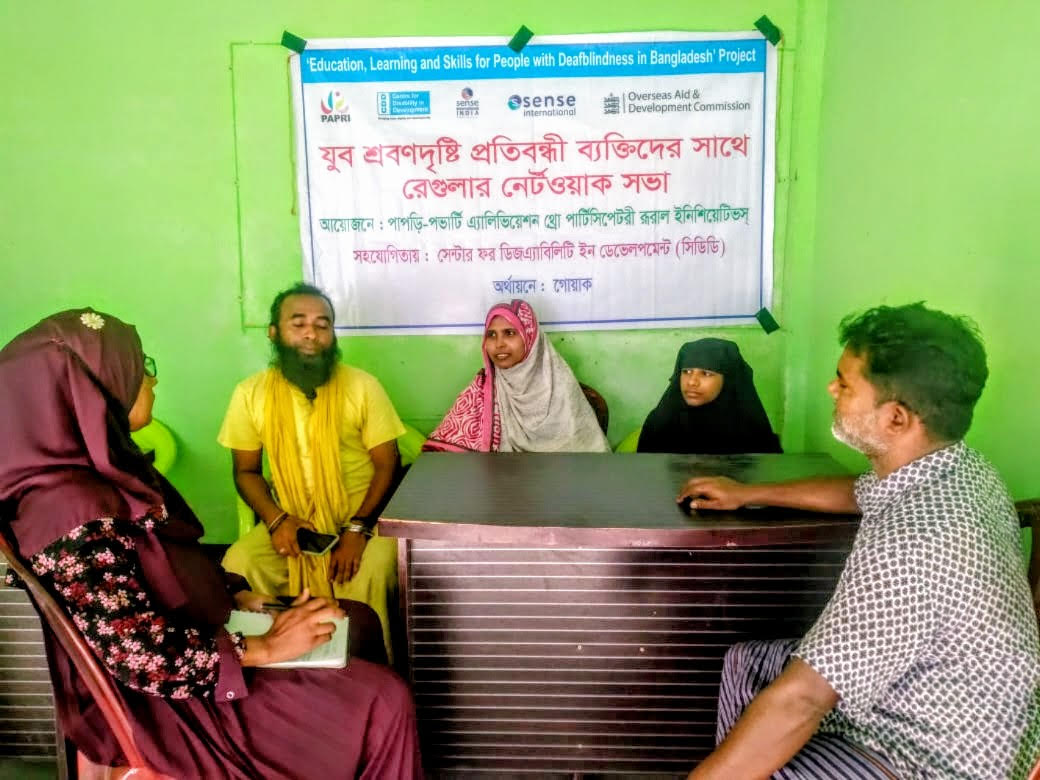
Through the Deafblind Project, services are being provided to children with hearing and visual impairments aged 0 to 30 years in five upazilas of Narsingdi district. The project is implemented by PAPRI in partnership with CDD, with financial support from Sense International UK and GOAC, and technical assistance from Sense International India.
Initially, identified deafblind individuals undergo Functional Assessment and Clinical Assessment to determine their levels of hearing and vision. Based on the results, appropriate communication methods and services are provided. An Individual Education Plan (IEP) is developed for each child.
Through home-based services, children receive training on Activities of Daily Living (ADL), such as brushing teeth, eating independently, bathing, dressing, buttoning clothes, using the toilet, holding a pen or pencil, recognizing colors, letters, and numbers, and learning simple words and sentences. Using appropriate Teaching and Learning Materials (TLM), these children gradually acquire various skills.
The project established a RRC center at PAPRI head office premises, where therapy and hearing-vision stimulation services are provided, which help improve their physical abilities as well as their hearing and visual functions. For children who have excessive drooling, therapy helps to reduce or stop it. Those who cannot hold their heads upright, sit, stand, or walk are receiving physical improvement through therapy.
Children requiring medical care are referred to neuro-medicine specialists, provided with medicines under the project, and connected to government hospitals for access to free medication.
The project also supplies assistive devices such as standing tables, standing boards, standing frames, walkers, toilet chairs, special chairs, corner chairs, hearing aid,law vision glass Wrist Hand Orthosis, and spectacles. Malnourished children are given nutritional support.
Those who are of working age receive Income Generating Activities (IGA) training to enhance their skills and are provided with cash support to start small income-generating activities—without any repayment requirement.
The project also works with Disability Service and Support Centers to obtain assistive devices and other essential services. Awareness meetings at district and upazila levels help ensure the rights of persons with disabilities.
To ensure school enrollment and education for deafblind children, meetings are held with students, teachers, and School Management Committee (SMC) members. Adaptations to the government curriculum are made, and training is provided to government and non-government teachers. Curriculum workshops are organized with education officers, teachers, parents, and disabled students, which has made learning easier for deafblind learners.
Parents of children with disabilities receive training to build their capacity so that they can better support the daily living of their children at home.
Project Purpose:
1. Inclusion deaf-blind people in society developing disable friendly infrastructures
2. Provide social support for deafblind children and their families.
3. Ensure the inclusion of disabled children in mainstream schools.
4. Organize training sessions on inclusive education for government officials.
5. Activate the regional network group .